
Exhibition "Alberto Pitta: eternity buried
Exhibition
- Nome: Exposição "Alberto Pitta: eternidade soterrada"
- Opening: 07 May 2022
- Visitation: until 30 June 2022
Local
- Venue: Carmo Johnson Projects
- Online Event: No
- Address: Rua Silvio Portugal, 193, Pacaembu
ALBERTO PITTA: ETERNITY BURIED
Renato Menezes
threads, cloths, folds
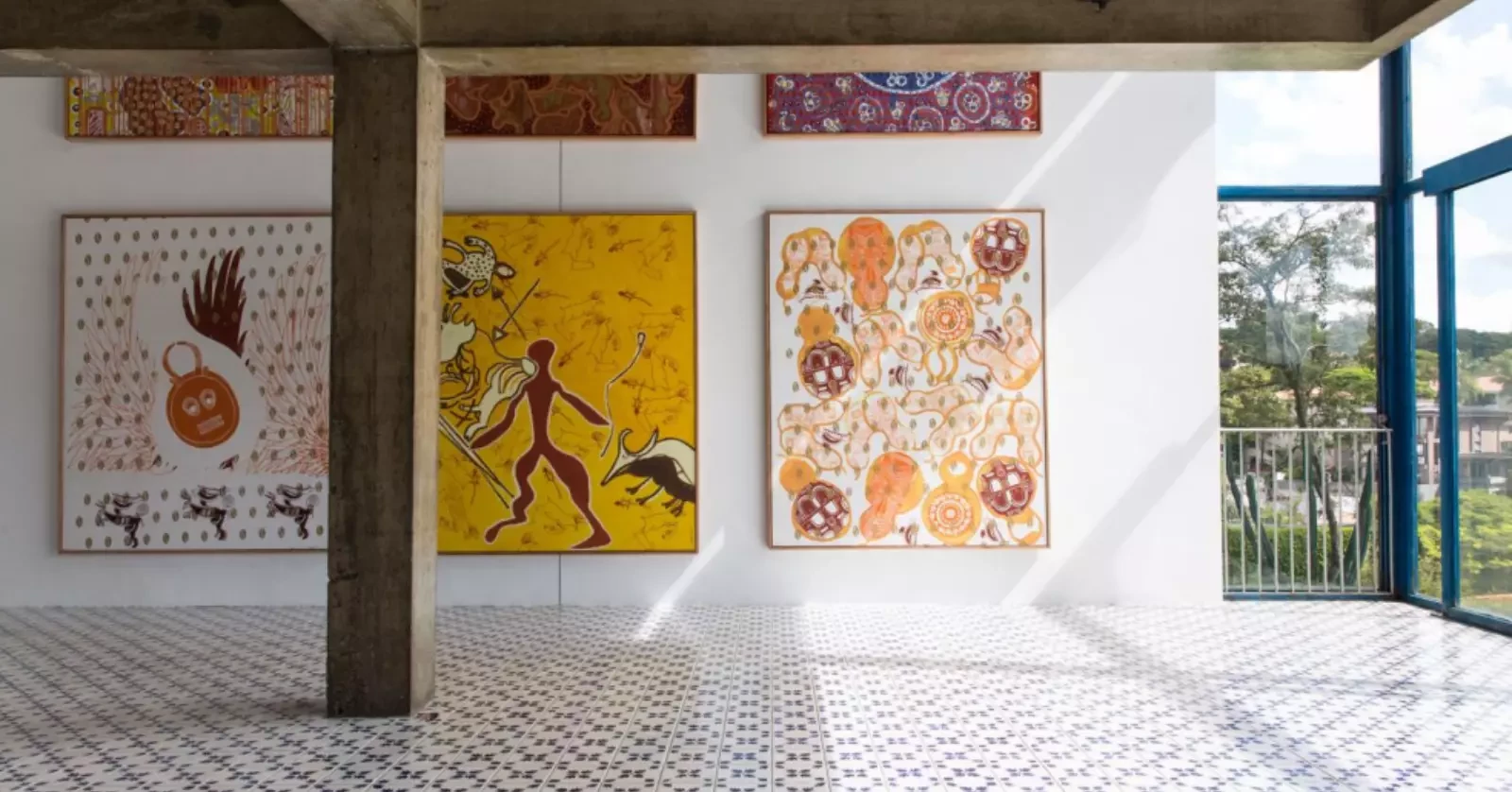
"He who knows yesterday and today, will know tomorrow, because the thread of the future, the woven cloth is the present, the cloth woven and folded is the past. past", says a Fulani proverb¹, which applies, with unusual precision, to the artistic to the artistic procedures of Alberto Pitta. For four decades he has been involved involved for four decades in the production of serigraphs and prints that colour the parades of the most emblematic blocos of Bahia's black carnival, Pitta uses thread, cloth and with threads, cloths and folds, a deep intimacy built daily throughout his life. daily throughout his life. Observing the activities of his mother, Mãe Santinha de Oyá, an important yalorixá from Salvador, who dedicated herself to richelieu embroidery and the education of children and adolescents in the community of Pirajá - following the community vocation of candomblé, Pitta saw her interest in cloth and her his interest in cloth and his commitment to bringing people together through words. He quickly understood that in the African tradition, from which he tradition, clothes do not only respond to the utilitarian need to protect the body the body; it could also be a powerful signifying element, which inscribes man in nature and reconnects him to his ancestors, affirming itself as a support of language and social markers².
In fact, signs, shapes and features that evoke traditional African graphics found, on their fabrics, a privileged place for the education of the education of the masses and the telling of stories that only make sense collectively. If in Pitta's work writing in Pitta's work is organized in a set of patterns and colours that reinterpret the Yoruba cosmovision, reading, on the other hand, concerns the established in the contact between bodies in movement, when the streets of the city of the city become a terreiro³. Through the folds of the fabrics that cover the revellers an alphabet of letters and affections, mobilized by music and dance, runs through them: it is in the body of the other that the text that completes us is read. It is in the printed where Pitta strengthens the principle of the Bantu, according to which the being does not exist in opposition to the other, but in contact with that which, in the other can alter him in search of the constant renewal of the meaning of life as an experience of beauty, joy and freedom4. "I write even for those who do not know how to read", says Pitta, as if preluding the famous verse by Roberto Mendes of Roberto Mendes and Capinan: "I will learn to read to teach my comrades". teach my comrades". For this reason, words can become indecipherable to the literate audience, while the symbols - masks, combs, adinkras, animals, gourds ritual objects - the most sophisticated hieroglyphics under the eyes of an illiterate. eyes of an illiterate. The print becomes, therefore, an activator of encounter, a device of communion, of connection between two worlds, of intercession of the arrows of time. Thus, the woven and folded cloth (which is the past) is made up of multiple possibilities of futures, the weaver's threads.
The tight weft formed by the threads of time, which accommodates the iconography
around which Pitta's work gravitates, is translated into the title of the exhibition.
Inspired by a verse by the Bahian poet Waly Salomão, "eternity
eternity" refers, on the one hand, to cave paintings and fossils, these remnants
remnants of the past crystallised in the present, which challenge the
life and emphasise the transformation of matter. This archaeological dimension of his
of his work is manifested in the accumulation of layers of colours and shapes
the power of serigraphy in transforming trace into graph -, in the work with soft and earthy
and earthy tones, and in the frequent allusion to the patinas and erosions caused by
time. On the other hand, the title also refers to the joy suffocated in the
domestic environment, in times of pandemic isolation, the period during which the
of works presented here was made.